
Under Construction... !
Under Construction... !
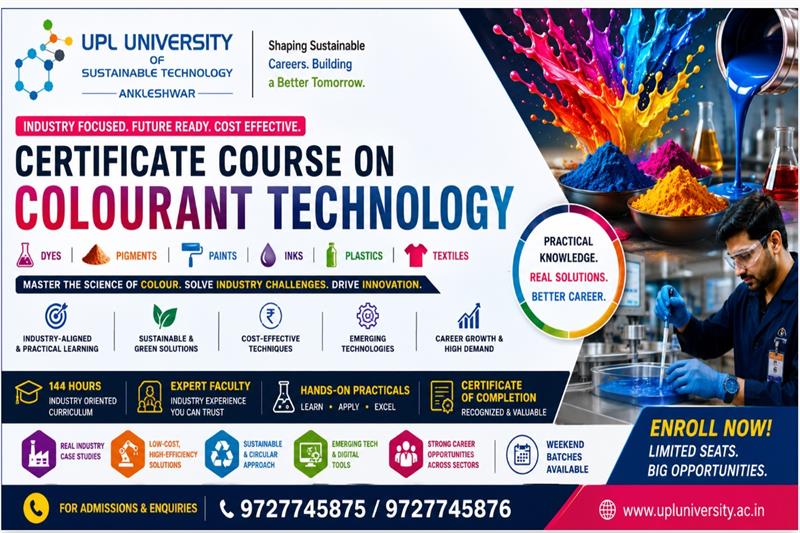
This certificate course is designed for students and professionals interested in
the colorant industry, including dyes, pigments, paints, inks, plastics, and textiles.
It provides fundamental and applied knowledge of color chemistry, formulation, processing,
and industrial applications.
The course integrates chemical technology, application techniques, quality control,
sustainability, and soft skills, enabling participants to build a strong foundation
for careers in colorant manufacturing and allied industries.
Course Prerequisites and Exemptions
Due to the technical nature of the course, the minimum eligibility is:
• 10th with 5 years of experience
• 12th with 3 years of experience
• Diploma / B.Sc. / M.Sc. (Chemistry / Chemical Technology / Polymer / Textile or
related fields)
Resources
• Study material in the form of notes, PDFs, and formulation sheets
• Industrial case studies and reference data
• Teaching Methodology
• Classroom lectures
• Laboratory practical sessions
• Demonstrations and industrial case discussions
• Assessment
One End Semester Examination after course completion
Practical/assignment-based evaluation (optional component)
Successful candidates will be awarded a Certificate of Completion in Colorant Technology
Course Fee, Enrollment, and Payment
• Course Fee: ₹35,000/-
• Payment Mode: DD/Cheque in favor of “UPL University of Sustainable Technology”
Terms and Conditions
• Full course fee must be paid at the time of registration
• Course Syllabus (Total Hours: 144 Hours)
Industry-Aligned | Sustainable | Cost-Effective | Emerging Tech Focus
Industry Oriented Syllabus (144 Hours)
Module 1: Real-World Colorant Industry & Problem Landscape (10 hrs)
• Today’s industry challenges: high energy, water, waste, cost pressure• Case studies: textile effluent rejection, paint recall due to shade variation
• Regulatory pressure: BIS, ZDHC, EU Reach, Indian Green Credit Scheme
• Industry expectations from a colorant technologist
Module 2: Cost-Effective Color Chemistry (16 hrs)
• Low-cost vs high-performance colorants• Alternatives to expensive heavy metals & rare organics
• Chromophore engineering for cost reduction
• Replacing toxic pigments with safe, cheaper alternatives
• Industry problem solved: *How to reduce RM cost by 15-20% without losing properties*
Module 3: Sustainable Dyes & Pigments – Circular & Low Carbon (18 hrs)
• Bio-based dyes (e.g., from agri waste, microbes)• Low-salt, low-water reactive dyes
• Heavy metal-free inorganic pigments
• Recycled pigment dispersions from post-consumer waste
• Carbon footprint calculation basics for colorants
• Live example: Zero-liquid discharge dyeing process
Module 4: Emerging Application Technologies – Industry 4.0 (16 hrs)
• AI and spectrophotometer-based digital shade matching• Automated dispensing systems (reduce waste by 30-40%)
• Plasma & supercritical CO₂ dyeing (waterless)
• Digital printing vs conventional – cost & sustainability comparison
• In-mold coloring for plastics – eliminating painting
Module 5: Low-Cost, High-Efficiency Processing (14 hrs)
• Energy-efficient milling & dispersion• Ultrasonic & bead mill vs ball mill – cost benefit
• Continuous vs batch processing – when and why
• Filtration & drying – reducing losses
• Problem solved: *How to reduce grinding time by 40% using nano-dispersion*
Module 6: Quality Control for Zero-Defect & Zero-Rejection (12 hrs)
• Fastness failures – real root cause analysis• Spectrophotometer – not just measurement, but prediction
• Particle size & shade strength correlation
• Statistical QC for small batch manufacturers
• Hands-on: Reject lot analysis & rework strategy
Module 7: Safety, Toxicology & Waste-to-Value (12 hrs)
• Chemical hazards in new generation colorants (e.g., azo-free but risky?)• MSDS, GHS labeling, and plant safety digital checklist
• Effluent treatment: color removal, sludge reduction, recycling
• Innovation: Using dye waste as construction colorant or ink feedstock
Module 8: Smart Instrumentation & Digital Tools (10 hrs)
• Low-cost IoT for viscosity & pH monitoring• Digital batch cards & formulation management
• Using Excel & Power BI for dye house productivity
• Cloud-based shade library for multiple plants
Module 9: Innovation & Future-Ready Colorants (12 hrs)
• Thermochromic, photochromic & conductive pigments• Self-cleaning & antimicrobial colorants
• Phase change material (PCM) pigments for cooling
• Startups & patent trends in colorant tech
• Group exercise: Design a low-cost, sustainable colorant for rural housing paint
Module 10: Industry-Attractive Soft Skills (14 hrs)
• Shift handover & batch documentation – error prevention• Cost reduction proposal writing for management
• Email & WhatsApp communication in chemical industry
• Interview Q&A focused on problem-solving, not textbook definitions
• Ethics: batch adulteration, over-specification, false eco-claims
Key Attractive Features for Industrial Employees
• Learn AI-based color matching in 4 hours• Reduce batch rejection by applying low-cost QC hacks
• Replace expensive pigments with bio-based or recycled alternatives
• Certificate with real problem statements solved
• Suitable for paint, ink, plastic, textile, and masterbatch employees
• Optional: MSME-focused cost-saving toolkit
Course Outcomes
By the end, participants will be able to:• Diagnose and solve real production problems (low strength, poor dispersion, shade mismatch)
• Replace costly or banned colorants with compliant, affordable alternatives
• Implement digital & automation tools even in small-scale plants
• Reduce water, energy, and waste in colorant application
• Propose new product ideas using emerging colorant technologies
A. Week-wise Delivery Plan (144 Hours over 12 Weeks)
*Format: 12 weeks, 12 hours/week (e.g., Sat.× 6 hours)*| Week | Module | Topics (Theory + Hands-on/Demo) | Industry Problem Solved |
|---|---|---|---|
| 1 | M1: Problem Landscape | Real cases of rejection, effluent, cost overruns; regulatory overview | Why colorants fail in market |
| 2 | M2: Cost-Effective Chemistry | Low-cost alternatives, safe substitutes, RM cost reduction | Reduce RM cost by 15-20% |
| 3 | M3: Sustainable Colorants (Part 1) | Bio-based dyes, low-salt reactive, agri-waste pigments | Replace banned/expensive dyes |
| 4 | M3: Sustainable Colorants (Part 2) | Heavy metal-free pigments, recycled dispersions, carbon footprint | Zero-liquid discharge approach |
| 5 | M4: Emerging Tech (Part 1) | AI shade matching, spectrophotometer demo, digital dispensing | Reduce shade mismatch rejections |
| 6 | M4: Emerging Tech (Part 2) | Waterless dyeing (supercritical CO₂, plasma), digital printing | 70% water reduction goal |
| 7 | M5: Low-Cost Processing | Ultrasonic milling, bead vs ball mill, continuous processing | 40% grinding time reduction |
| 8 | M6: QC for Zero Defect | Fastness root cause, particle size-shade correlation, rework strategy | Zero rejection batch target |
| 9 | M7: Safety & Waste-to-Value | MSDS digital checklist, ETP color removal, dye waste as new product | Turn waste into revenue |
| 10 | M8: Smart Digital Tools | IoT for viscosity, digital batch cards, Power BI for productivity | Low-cost digitalization |
| 11 | M9: Future-Ready Colorants | Thermochromic, antimicrobial, PCM pigments; patent trends | New product design exercise |
| 12 | M10: Soft Skills + Project | Cost proposal writing, interview prep, case study viva | Employability & promotion readiness |
• Weekend batches: 6 hours Sat + 6 hours Sun.
B. Industry Case Study Bank (12 Real-World Problems)
These are designed to be solved in 30-45 minutes during class, in groups.| Week | Case Study Title | Industry Segment | Problem | Expected Solution Approach |
|---|---|---|---|---|
| 1 | "Shade mismatch in consecutive batches" | Paint (automotive) | Same formula, different shade due to dispersion variation | Check milling time, particle size, raw material lot variation |
| 2 | "Reactive dye effluent color exceeds ZDHC limit" | Textile dyeing | High color in ETP outlet despite treatment | Low-salt dye + ozone/adsorption polishing |
| 3 | "Pigment settling in ink during storage" | Printing ink | Poor dispersion stability | Adjust wetting agent, grind to finer particle size |
| 4 | "High cost of organic pigment – losing tender" | Industrial coatings | Competitor 18% cheaper | Partial replacement with hybrid inorganic-organic pigment |
| 5 | "Vat dye reduction failure on jigger" | Textile (denim) | Inconsistent color yield | Check hydrosulphite dosing, air ingress, temperature control |
| 6 | "Yellowing of white paint on curing" | Decorative paint | Unsightly customer complaint | Change TiO₂ grade or add UV stabilizer |
| 7 | "Disperse dye staining on polyester-spandex" | Synthetic textile | Poor fastness to rubbing | Optimize reduction clearing cycle |
| 8 | "Low tinting strength in yellow pigment batch" | Pigment manufacturing | 15% weaker than standard | Check reaction pH, drying temperature, crystal form |
| 9 | "Foaming in pigment dispersion during grinding" | Ink & coating | Production slowdown | Add defoamer, change recirculation rate |
| 10 | "Effluent sludge disposal cost too high" | Dye intermediate plant | ₹50/kg disposal cost | Dewater + use as construction block filler |
| 11 | "Digital shade matching gives 3 different results from 3 instruments" | Quality lab | Calibration drift | Single master instrument, regular ceramic tile calibration |
| 12 | "Customer demands GOTS-approved but cheap black colorant" | Sustainable textiles | Conflicting requirements | Use iron-based black + bio-mordant instead of azo black |
C. Low-Cost Lab Experiments (Minimal Equipment, Maximum Learning)
These experiments use < ₹5000 worth of equipment (excludes spectrophotometer if not available – use visual standards or smartphone apps).| Sr. No. | Experiment Name | Equipment/Items Needed | Learning Outcome | Time |
|---|---|---|---|---|
| 1 | Visual shade matching under different light sources | D65 lamp, tube light, yellow bulb, color swatches | Metamerism understanding | 30 min |
| 2 | Simple pigment dispersion test – drawdown | Drawdown bar or glass rod, paper/substrate | Dispersion quality assessment | 20 min |
| 3 | Rub fastness test (dry & wet) | Crockmeter cloth (or white cloth + finger pressure), sample | Basic fastness evaluation | 15 min |
| 4 | pH vs dye uptake – visual comparison | Beakers, pH strips, cotton fabric, reactive dye | Dyeing optimization | 45 min |
| 5 | Sedimentation test for pigment slurry | Graduated cylinder, stopwatch | Dispersion stability | 24 hr (observe intervals) |
| 6 | Salt concentration effect on dye exhaustion | Common salt, 2-3 beakers, fabric strips | Low-salt dyeing importance | 30 min |
| 7 | Simple spectrophotometer substitutes – using smartphone RGB app | Smartphone (Color grab or RGB app), white paper, colored samples | Digital color basics | 20 min |
| 8 | Coating opacity test using black-white chart | Opacity chart, paint sample, film applicator (or card) | Hiding power measurement | 15 min |
| 9 | Viscosity comparison using Ford cup (DIY) | DIY cup with drilled hole (calibrated), stopwatch | Viscosity basics | 20 min |
| 10 | Effluent color reduction using adsorbent (charcoal/fly ash) | Colored wastewater, activated charcoal/ash, filter paper | Simple remediation | 30 min |
| 11 | Waste dye reuse as ink | Waste reactive dye solution, gum arabic, pen/brush | Circular economy | 30 min |
| 12 | Particle size feel test – grinding comparison | Finger test, glass slide, different milled samples | Grinding effectiveness | 15 min |
